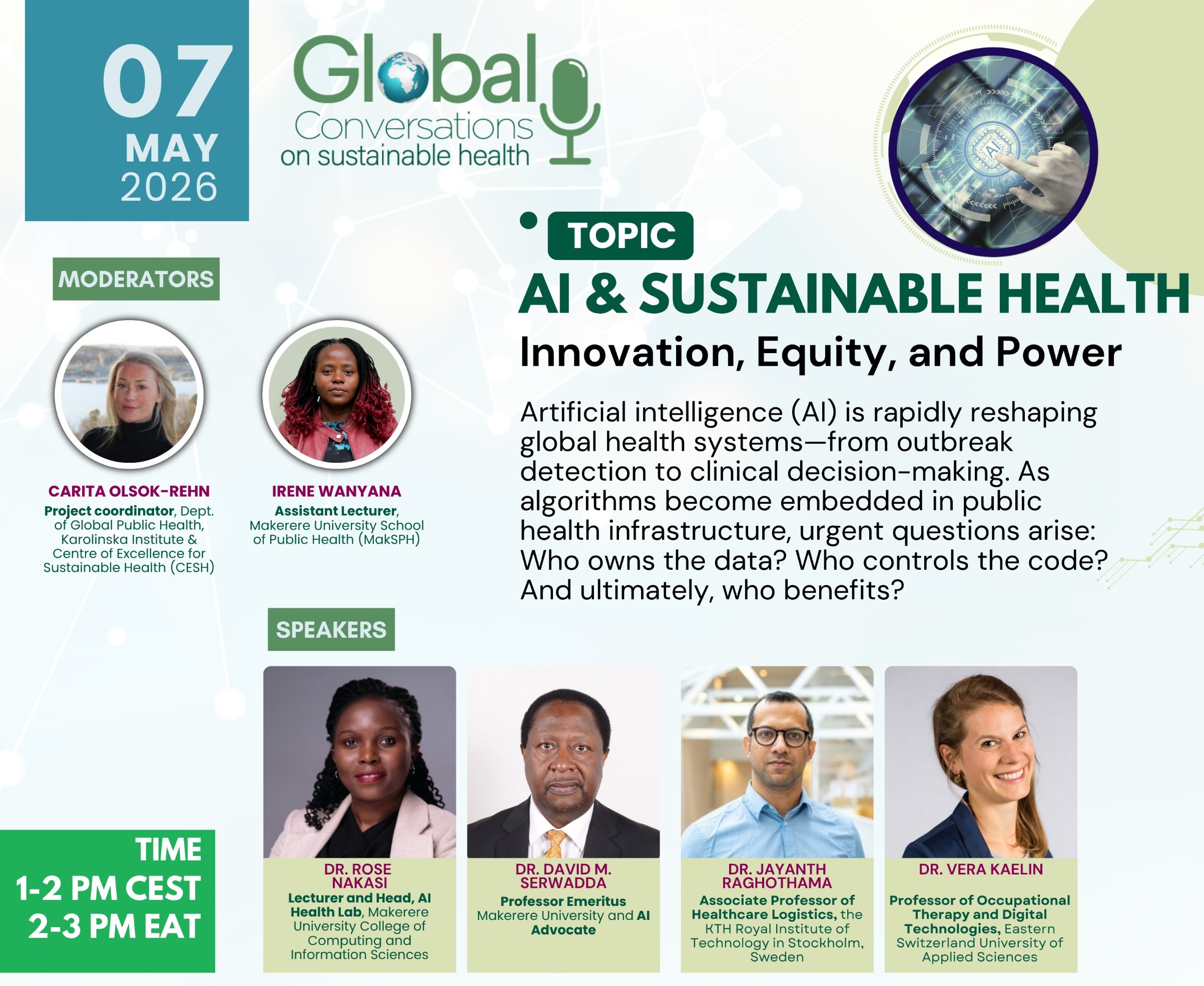
Global Conversation 7 May 2026: AI and Sustainable Health – Innovation, equity and power

On 7 May 2026, the Global Conversation on AI and Sustainable Health brought together 87 participants from 19 countries for an international dialogue on the opportunities and challenges of artificial intelligence in health systems, with particular emphasis on innovation, equity, governance, data ownership, inclusion, and the fair distribution of benefits.
Watch the recorded conversation
The event featured contributions from Dr Rose Nakasi and Dr David M. Serwadda of Makerere University, Dr Jayanth Raghothama of KTH Royal Institute of Technology, and Dr Vera Kaelin of the Eastern Switzerland University of Applied Sciences, whose perspectives highlighted the importance of responsible and inclusive approaches to AI in global health. Participants represented a wide range of universities, educational institutions, and organisations across Africa, Europe, North America, and Asia, reflecting strong international engagement and interdisciplinary collaboration around the future of sustainable health.
This session, part of the Centre of Excellence for Sustainable Health's (CESH) global conversation series, focused on the intersection of artificial intelligence (AI) and sustainable health, exploring themes of innovation, equity, and power.
The discussion highlighted AI's transformative potential in health, particularly in diagnostics, disease surveillance, supporting healthcare workers, and expanding access to care. However, speakers emphasized challenges around equity, representation, data ownership, and power dynamics. The importance of expert validation in AI-driven healthcare was repeatedly noted, with current best practices involving multiple layers of expert data annotation and human oversight to mitigate data gaps and model discrepancies.
Panelists addressed the limitations of AI tools in accounting for geographical and contextual differences on sensitive global health issues, such as abortion, gender-based violence, and HIV-related services. They cautioned against relying solely on AI for deep or meaningful support in these areas, underscoring the continuing necessity for human expertise, especially in mental health and well-being.
The conversation also recognized barriers to developing regionally and contextually relevant AI models, particularly in low- and middle-income countries. Issues include a lack of locally representative data, economic challenges in supporting small-scale models, and the need for significant investment from governments and partners. Suggestions were made to adapt existing models for local contexts and to foster partnerships to facilitate clinical trials and drug access.
In closing, the session called for ongoing dialogue, local investment, and collaboration to ensure AI-driven health solutions are equitable, context-sensitive, and sustainable. Participants were reminded to suggest future discussion topics and connect with SESH for further engagement.